
Hungary Meets Georgia: Easy Goulash and Caucasian Comfort Food You Can Make Tonight
Oct 2, 2026
# Hungary Meets Georgia: Easy Goulash and Caucasian Comfort Food You Can Make Tonight
Some of the best meals in the world were born out of necessity. Not out of a gleaming chef's kitchen stocked with specialty imports, but out of a cold Tuesday night, a fridge that needs emptying, and a hunger that demands something real. Hungarian goulash and Georgian chakhokhbili — two dishes from very different corners of Europe — both have that origin story baked into their bones. They are peasant food, traveler food, shepherd food. And that is exactly why they taste so incredible.
Hungary and Georgia sit on opposite ends of a cultural and geographical arc, yet both countries have cultivated deeply spiced, deeply satisfying stew traditions that punch far above their weight class in terms of flavor complexity. Hungarian goulash leans on sweet and smoked paprika, slow-softened onions, and tender beef to create something that tastes like it has been simmering since morning — even when it hasn't. Georgian chakhokhbili, a braised chicken dish fragrant with fresh herbs, tomatoes, and fenugreek, brings a brightness that surprises you the first time you taste it, then becomes immediately addictive.
Tonight, we're going to make both. Well, you're going to choose your adventure — or make both if you're feeding a crowd or just feeling ambitious. Either way, these are fridge-raid recipes designed for real life: flexible with ingredients, forgiving with technique, and absolutely guaranteed to make your kitchen smell like somewhere you'd want to be.
---
Why These Two Dishes?
Beyond their shared roots in resourceful, rural cooking, goulash and chakhokhbili both reward the same cooking instincts: patience with the onion base, generosity with aromatics, and trust in the process. If you've ever stood in front of your fridge wondering how to transform a lonely onion, some forgotten peppers, a protein of dubious date, and a jar of something spicy into dinner — these recipes were written for you.
Let's start with the goulash, then move into Georgian territory.
---
Recipe 1: Hungarian-Inspired Beef Goulash
Ingredients
Serves 4 | Prep: 15 mins | Cook: 55 mins
- 500g (1.1 lb) beef chuck or stewing beef, cut into 3cm cubes — sub: pork shoulder, lamb, or even mushrooms for a vegetarian version
- 3 large onions, finely diced — don't rush this step; the onions are the soul of goulash
- 3 tablespoons neutral oil or lard — lard is traditional and adds depth; use whatever you have
- 3 tablespoons sweet Hungarian paprika — this is non-negotiable; it should be good quality and fragrant, not dusty and old
- 1 teaspoon smoked paprika — adds a subtle smokiness
- 1/2 teaspoon caraway seeds, lightly crushed
- 3 garlic cloves, minced
- 2 medium tomatoes, roughly chopped — or 1 tablespoon tomato paste in a pinch
- 2 medium bell peppers (red or yellow), diced — sub: any peppers you have, or omit
- 700ml (3 cups) beef stock or water — stock gives richer flavor; water works fine
- 2 medium potatoes, peeled and cubed — optional but makes it a full one-pot meal
- Salt and black pepper to taste
- Fresh parsley to serve
- Sour cream, to dollop on top — highly recommended
Instructions
- Build your onion base. Heat the oil in a heavy-bottomed pot or Dutch oven over medium-low heat. Add the diced onions and a pinch of salt. Cook low and slow, stirring occasionally, for 15–20 minutes until deep golden and jammy. This is where most people rush and most goulashes fail. The onions need to essentially melt.
- Add the paprika. Pull the pot off the heat or lower it to the lowest setting. Add the sweet paprika, smoked paprika, and caraway seeds. Stir quickly for 30–40 seconds — you'll smell a bloom of warmth and earthiness. The residual heat is enough; paprika burns fast and turns bitter if you're not careful.
- Brown the beef. Return to medium-high heat. Add the beef cubes and stir to coat in the paprika-onion mixture. Let the meat sear for 4–5 minutes, stirring occasionally, until browned on most sides. Season with salt and pepper.
- Add aromatics and tomatoes. Stir in the garlic, chopped tomatoes, and bell peppers. Cook for another 3 minutes, until the tomatoes begin to soften and release their juices.
- Add liquid and simmer. Pour in the stock, stir everything together, and bring to a gentle boil. Reduce to a low simmer, cover partially, and cook for 30 minutes.
- Add potatoes. If using, add the cubed potatoes now and continue simmering for another 20–25 minutes, until both the beef is fork-tender and the potatoes are cooked through. The broth should be thick and richly colored.
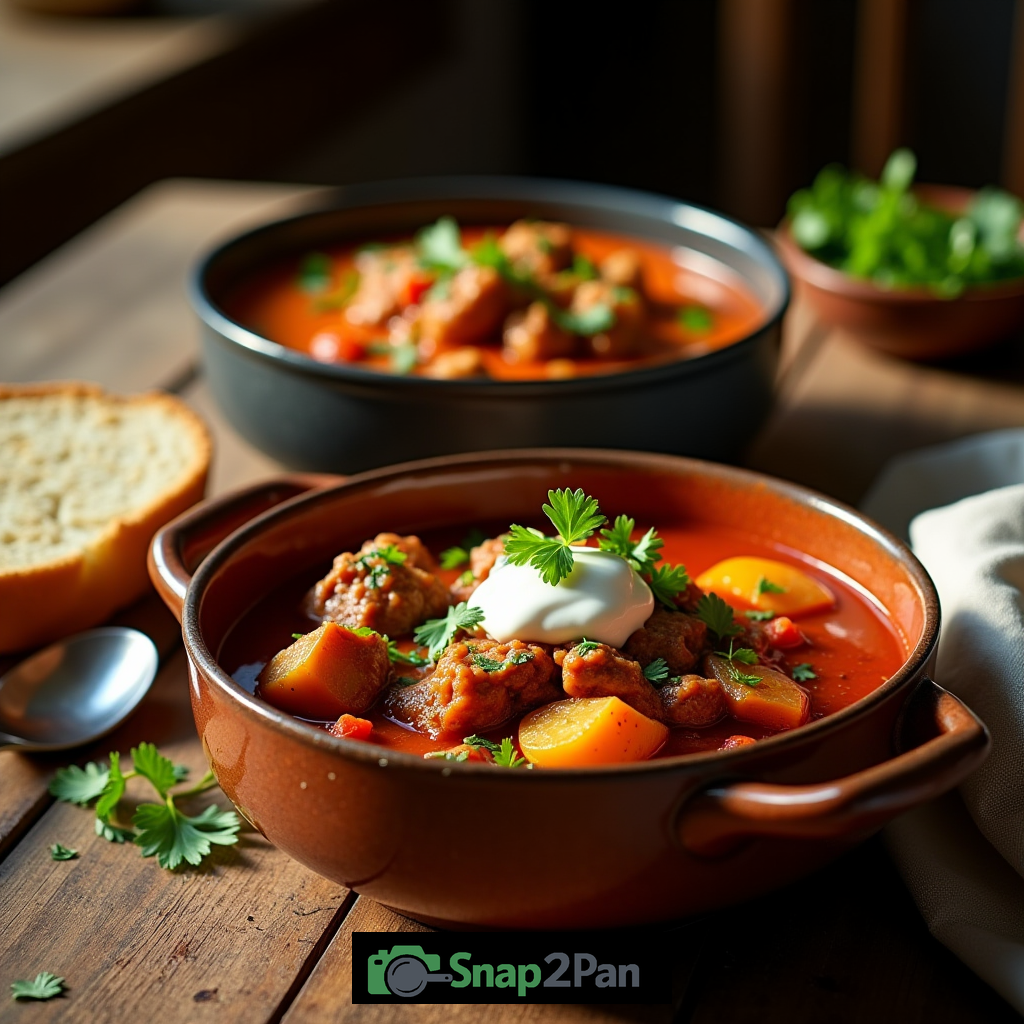
- Taste and finish. Adjust salt and pepper. Ladle into deep bowls, scatter with fresh parsley, and add a generous spoonful of sour cream on top. Serve with crusty bread to mop up every last drop.
Recipe 2: Georgian Chakhokhbili (Braised Chicken in Tomato and Herb Sauce)
Ingredients
Serves 4 | Prep: 10 mins | Cook: 45 mins
- 1 whole chicken, jointed into 8 pieces — or 1kg bone-in, skin-on thighs and drumsticks
- 3 tablespoons butter — or ghee for a richer version
- 3 large onions, thinly sliced
- 5 ripe tomatoes, roughly chopped — or one 400g (14oz) can of crushed tomatoes
- 4 garlic cloves, minced
- 1 teaspoon ground fenugreek — the signature Georgian spice; sub with a pinch of mustard powder if truly unavailable
- 1 teaspoon ground coriander
- 1/2 teaspoon turmeric
- 1/2 teaspoon chili flakes or one fresh chili, finely chopped — adjust to heat preference
- 1 large bunch fresh cilantro, roughly chopped
- 1 large bunch fresh parsley, roughly chopped
- Small bunch of fresh basil — optional but beautiful
- Juice of half a lemon
- Salt and pepper to taste
- Flatbread or rice to serve
Instructions
- Dry and sear the chicken. Pat the chicken pieces completely dry with paper towels. Heat butter in a wide, heavy pan over medium-high heat until foaming. Sear the chicken pieces skin-side down for 5–6 minutes until deeply golden and crisp. Flip and cook another 3 minutes. Remove and set aside. Do not skip the sear — it creates foundational flavor.
- Soften the onions. In the same pan with the remaining butter and rendered chicken fat, add the sliced onions. Cook over medium heat for 12–15 minutes until soft, sweet, and just beginning to color.
- Add spices and garlic. Add the garlic, fenugreek, coriander, turmeric, and chili. Stir for 1–2 minutes until fragrant — the turmeric will turn everything a gorgeous gold.
- Add the tomatoes. Add the chopped tomatoes (or canned), stir everything together, and cook for 5 minutes until the tomatoes break down into a thick, jammy sauce. Season generously with salt and pepper.
- Braise the chicken. Nestle the seared chicken pieces back into the pan, skin-side up. Cover and cook on low heat for 25–30 minutes, until the chicken is completely cooked through and beginning to fall from the bone. The sauce will thicken beautifully.
- Finish with herbs and lemon. Uncover, scatter over the fresh cilantro, parsley, and basil. Squeeze over the lemon juice. Stir gently and taste for seasoning. Cook uncovered for one final 2–3 minutes so the herbs just wilt into the sauce.
- Serve immediately with warm flatbread or steamed rice. The fresh herbs are not garnish — they are a primary ingredient, so don't hold back.
Tips & Variations
1. The paprika in goulash matters more than almost anything else. If your paprika has been sitting in the back of the spice drawer for over a year, buy a new jar. Dull paprika makes dull goulash. Look for Hungarian or Spanish varieties at specialty stores — the difference in aroma and color is night and day.
2. Chakhokhbili is extraordinary with leftover roast chicken. Skip the initial sear and add the pre-cooked chicken in Step 5, reducing braising time to just 10 minutes to warm through. It transforms tired leftovers into something magnificent.
3. Make goulash vegetarian by using smoked mushrooms and root vegetables. A combination of portobello mushrooms, parsnips, and carrots gives remarkable depth, especially with a tiny splash of soy sauce added alongside the stock for umami.
4. Add a splash of dry white wine to chakhokhbili after the onions are soft. Let it bubble away for a minute before adding tomatoes. It adds complexity that feels traditionally Georgian even though wine is a flexible addition.
5. Both dishes are significantly better the next day. If you can plan ahead, make them the night before and simply reheat. The spices meld, the proteins relax, and the sauces deepen in a way that fresh cooking simply can't replicate.
---
Storage & Reheating
Both the goulash and chakhokhbili store beautifully, making them perfect meal prep candidates.
Refrigerator: Store cooled leftovers in airtight containers for up to 4 days. The flavors improve daily.
Freezer: Both dishes freeze extremely well for up to 3 months. Freeze in individual portions for easy weeknight rescues. Note: potatoes in goulash can become slightly grainy after freezing — if you plan to freeze, add fresh potatoes when reheating instead.
Reheating: Reheat gently on the stovetop over medium-low heat with a splash of water or stock to loosen the sauce. Avoid high heat, which can toughen the meat. Chakhokhbili is best reheated covered in a pan for about 10 minutes. Add fresh herbs after reheating for brightness.
---
Nutrition Notes
Goulash is a protein-rich, iron-boosting dish thanks to the beef, and the bell peppers and tomatoes contribute a solid hit of vitamin C — which actually helps your body absorb the iron more effectively. The paprika isn't just flavorful; it's genuinely rich in antioxidants.
Chakhokhbili is a lean-protein powerhouse when made with chicken thighs (which provide more nutrients and flavor than breast), and the avalanche of fresh herbs — cilantro, parsley, basil — adds meaningful vitamins and anti-inflammatory compounds. Fenugreek, the signature Georgian spice, has a long history of use in traditional medicine for digestive health and blood sugar balance.
Both dishes are naturally gluten-free, and both can be adapted for dairy-free diets by omitting the sour cream and using oil instead of butter.
---
FAQ
Q: Can I make goulash without a Dutch oven or heavy pot? A: Absolutely. Any pot with a lid and a thick enough base will work — even a deep, wide frying pan in a pinch. The key is even, controlled heat for the onion stage, so if your pan runs hot, just lower the flame and stir more frequently. A slow cooker also works wonderfully: sear the meat separately, build the base on the stove, then combine everything in the slow cooker on low for 6–8 hours.
Q: I can't find fenugreek — is chakhokhbili worth making without it? A: Yes, absolutely — though fenugreek is what gives Georgian food that distinctly warm, slightly bitter, maple-adjacent note that sets it apart. If you can't find ground fenugreek, a small pinch of dry mustard powder and a pinch of celery seed together approximate it reasonably well. Many online spice retailers carry it for very little cost and it's worth having in your pantry if you cook any South Caucasian or Indian food.
Q: My goulash broth seems too thin. How do I fix it? A: Simply remove the lid and let it simmer uncovered for 10–15 minutes until the liquid reduces to your preferred consistency. Alternatively, mash one or two of the potato pieces against the side of the pot — they'll naturally thicken the broth. Avoid adding flour or cornstarch unless absolutely necessary, as it changes the texture and traditional character of the dish.
Q: Can I combine elements of both dishes into one? A: This is an inspired idea and actually works. Try a paprika-spiced chicken braise with Georgian herbs — use the chakhokhbili technique (tomato base, fresh herbs, lemon) but season it with Hungarian paprika and caraway instead of fenugreek and turmeric. The result is a hybrid that feels completely coherent and utterly delicious. Food has no borders when it tastes this good.
---
Whether you lean into the deep, crimson-lacquered warmth of a Hungarian goulash or the herby, golden vibrancy of a Georgian chakhokhbili tonight, you're cooking food that has fed and comforted people for centuries. That's not a small thing. Set the table, make it good, and enjoy every bite.